|
How to Perform CPR+AED for Adults
Around 3,000 out-of-hospital cardiac arrests (OHCA) occur in Singapore every year, with 70% – 80% of cardiac arrest cases happening either at home or in public places. For every minute that nothing is done to resuscitate the victim, their chance of survival drops by 10%. In such a situation, bystander CPR+AED plays an effective role in saving the patient through the golden hour.
If you notice someone who needs help, do not panic. Just remember DRS ABC.
Check for Danger
Ensure that the surrounding is safe for you to approach the casualty.
Check for Response
Tap firmly on the casualty’s shoulders, and ask, “Hello hello, are you ok?”
Shout for Help
Ask someone to call 995 for an ambulance. You can also use the myResponder app to dial 995 and send your geolocation directly to the Singapore Civil Defence Force (SCDF) for faster dispatch of emergency resources to the scene.
Put your phone on speaker mode and follow the SCDF dispatcher’s instructions.
Ask for an AED
Ask someone to get an AED. The myResponder app also shows you where to locate the nearest AEDs.
To retrieve the AED from the cabinet, use a solid or sharp object like a key or pen and strike confidently at the centre of the glass where the key was kept and retrieve the key. Do not use your bare hands.
Check for Breathing
Look for the rise and fall of the casualty’s chest.
Early CPR
If the casualty is not breathing, breathing abnormally, or when you are in doubt, start CPR immediately. For every minute that nothing is done to resuscitate the victim, the chance of survival drops by 10%.
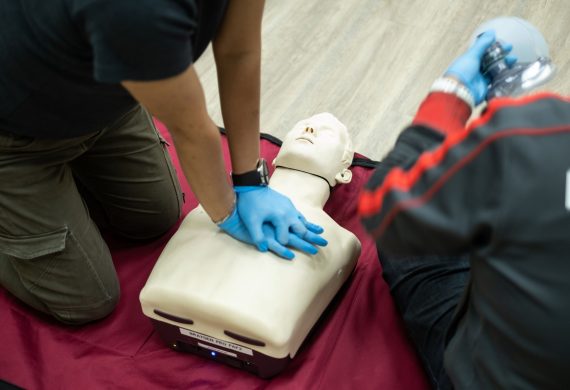
Follow these steps for chest compressions*:
- Kneel with knees slightly apart.
- Interlace fingers.
- Place the heel of your hand on the lower half of the sternum (breastbone).
- Position your shoulders directly over the casualty’s chest.
- Straighten both elbows and lock them in position.
- Use bodyweight to achieve a compression depth of 4 – 6cm and compress at a rate of 100 – 120 compressions per minute. The chest should fully recoil (comes up all the way) after each compression.

When the AED arrives, follow these steps:
-
- Use the AED in a safe environment.
Check the area to ensure there is no wet or metallic surface or flammable gas.
Always continue CPR until the AED is ready for analysis.
-
- Turn on the AED and follow the voice prompt.
Put on your gloves, shift any jewellery on the casualty’s body to the side.
Roll up the casualty’s shirt and shave any chest hair. Remove medical patches, and wipe dry the chest. Ensure chest is bare, dry and clean.
-
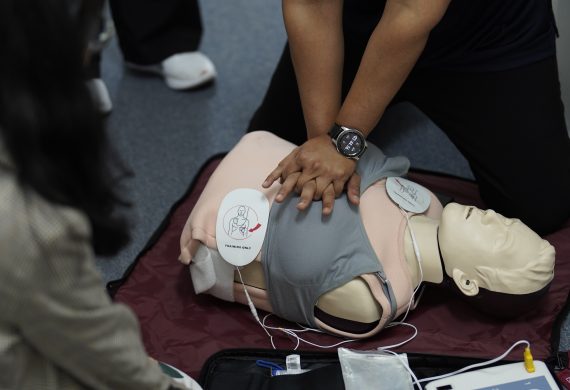
- Place the AED electrode pads.
Apply AED pads firmly to the bare chest according to the diagram: one on the upper right chest under the collarbone and the other on the lower left below his left nipple.
If the casualty has a pacemaker, you have to place the AED pad four fingers away from it.
-
- AED analysing.
When the AED starts analysing heart rhythm, no one should touch the casualty. Spread both arms out and shout “Stay Clear”.
-
- When the AED prompts:
Shock advised
|
No shock advised Resume chest compressions and follow the AED prompts. |
Stop CPR only when the AED is analysing heart rhythm, when the casualty wakes up or regains normal breathing, or when the paramedics take over.